
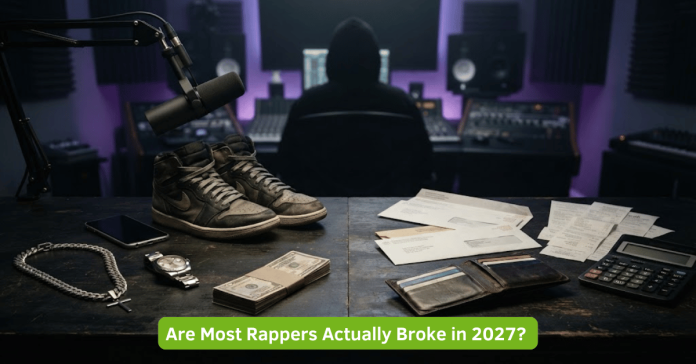
Rap music sells a dream that shines. The Lamborghini parked outside the mansion, the ice-covered chain glistening in the light of the camera, the designer’s suit and tie that cost more than a year’s rent. Over the last 50 years, hip hop has been constructed around the visual symbols of wealth and fans have been educated to interpret any flex as a testament to wealth. So, who really is broke, if any, and who really isn’t as much as it seems in those videos anyway, is the point I’ll ask you, straight up? How much of that radiance is genuine cash, and how much is a costly production performed for the algorithm?
The secret is in streaming math, contract fine print, rented props and some artists who got the code right while many other artists went under the radar.
The Real Economics of Being a Rapper
What Streaming Actually Pays
Streaming saved the music industry, but not all artists made money. According to the IFPI’s Global Music Report 2026, global revenues for recorded music reached an all-time high of USD 31.7 billion in 2025, with almost 70 percent of that generated from streaming. That’s over $11 billion paid in royalties by Spotify alone.
Those numbers in the headline mask the distribution issue. Spotify does not offer a set fee per play. It pays rights holders a portion of revenue according to their share of total streams, estimated to be around a third of a cent to half a cent per stream. That cash goes to the label/distributor and the publisher first. If a rapper has a standard contract, the recording royalty may be as low as 15% – and only after the advance is repaid.
The curve is steep, as Spotify’s own Loud and Clear report goes to demonstrate. Over 1,500 artists earned more than 1 million dollars across Spotify in 2025, whereas the 100,000th highest earning artist only earned just over 7,300 dollars. In addition, tracks must have a minimum of 1,000 streams during the last year to qualify for royalties being paid.
Touring and Merchandise Pay the Real Bills
The stage is where the money is, for most working rappers. In 2025, Live Nation earned 25.2 billion dollars and had 159 million fans attend its shows. Much of the gross is consumed before the artist receives a check due to production, travel, crew, security, and management commissions. Smart artists consider merch as a legitimate product and not an afterthought and it generally boasts higher margins.
Flex Culture and the Price of Looking Rich
Performing Wealth You Do Not Have
So, in hip hop, the ability to look good is part of the job description. Fans, labels and brands are drawn to the image of money – artists are pressured to demonstrate it before they have it. The pressure is what gets a young man with one viral hit into buying jewelry instead of paying taxes.
Rented Chains and Borrowed Lamborghinis
Many of the things you see on the screen are fleeting. In the video, exotic cars are often rented to shoot the video, and luxury cars in daily life are also often leased. Jewelry is the same. The Wall Street Journal issued a report in 2009 that during the recession, the jewels’ industry had been hearing from the rappers asking to have jewelry fashioned with less expensive stones and metals, and some even wanted cubic zirconia. In the same year, a stolen rapper chain, from Plies, was heavily reported as being a cubic zirconia set in gold. The camera does not make the distinction; that’s the purpose.
Verified Cases of Rich on Camera, Broke on Paper
50 Cent and the Bankruptcy Twist
Few rappers had more words to go around than 50 Cent with his first album titled Get Rich or Die Tryin’. But in July 2015, he filed for Chapter 11 bankruptcy, with debts totaling approximately $36 million and $20 million in assets, including one large judgment based on a failed venture into the headphones business. In 2017, he paid back over $22 million and the case was dismissed. There is no magic that can keep anyone safe from lawsuits or liquidity issues.
Kanye West and the 53 Million Dollar Tweet
Kanye West posted in February 2016 to show that he was $53 million personally in debt, which was assumed to be related to his fashion company expenses. He then went on to make himself a billionaire with his tie up with Adidas but in 2022, Adidas terminated the relationship. Most of the fortune went on one contract and when that one went away, so did that billion.
The Bankruptcy Club
MC Hammer, DMX (who has filed for bankruptcy numerous times) and Xzibit have all gone bankrupt. Hammer’s filing in 1996 was the cautionary tale of the times. He had tens of millions of records sold, and an impressive payroll, but when the hits diminished, the costs exceeded the revenues.
The Label Deal Problem
When Success Does Not Equal Payment
More rags have been lost due to bad contracts than by any shopping spree. One of the top selling rappers in the world, Lil Wayne, sued Cash Money Records for 51 million dollars in the year 2015, claiming for unpaid advances whilst Tha Carter V languished on the shelf for several years. The issue was resolved in 2018.
Megan Thee Stallion has admitted that she did not receive all of the details of her deal with 1501 Certified Entertainment when she was first inked, but has since learned more about the situation upon joining the Roc Nation organization in 2019 and having her contract reviewed by lawyers. It would leave the label with 60 percent of her recording revenue, she said in a statement, adding that the agreement was “unconscionable. In October 2023, the parties came to a confidential settlement.
Advances Are Loans, Not Gifts
An advance is like a salary to many young artists. It is, in fact, recoverable from future royalties, and on 360 deals, labels may even receive a percentage of touring, merchandising and endorsements. A million units sold doesn’t necessarily mean a million units due to the label.
The Financial Education Gap
Most of the rappers get their big break when they are in their late teens to early twenties, and in the neighbourhood where none of their friends have ever made it to six or seven figures. Now they have a big check, entourage, family responsibilities and a management fee. No one gives them a class in taxes, recoupment or diversification.
Money comes in sporadic bursts, taxes are low-balled, and living expenses are fixed, and revenue is variable. So it is no wonder that the question of which rappers broke is constantly resurfacing. It is not that they never made any money. It’s because there was no structure in terms of the money.
The Rappers Who Built Real Wealth
Jay-Z and the Ownership Mindset
In 2019, Jay-Z was named hip hop’s first billionaire by Forbes, and in 2021, Forbes’ estimate of his net worth was approximately 2.5 billion dollars. It’s hardly from album sales. In 2021, he sold half of his Armand de Brignac champagne block to LVMH’s Moet Hennessy while in 2023, he sold his D’Usse cognac block to Bacardi at roughly $750 million. From Roc Nation to real estate to an art collection, you have a portfolio and no paycheck.
Drake, Dr. Dre, and the Equity Lesson
By transforming his name into equity, Drake has turned OVO into a record label and clothing brand. Dr. Dre did the same with Beats, which Apple bought in 2014 for about 3 billion dollars. Even 50 Cent has recovered from bankruptcy by going through television production. The playbook remains easy to follow: to have some asset, to diversify early and never to have one income stream own the whole empire.
What the Money Looks Like Heading Into 2027
Streaming Is Growing, but Slowly for Most
Streaming revenue continues to rise, Spotify pays out about half of the royalties to independent artists and labels, and there are now even more artists earning six-figures from streaming. However, streaming fraud and AI generated content were also cited as major issues by IFPI, who both seek to access the same pool of royalties.
Live Music and Brand Deals Lead the Way
Live Nation reported that over 80 per cent of its 2026 large venue events are sold out through February and its sponsorship division made over $1.3 billion in 2025. Brand partnerships, equity deals, and direct to fan sales are as crucial for rappers taking on 2027 as the music itself. Artists who retain Masters have distinct advantage.
So, Are Most Rappers Actually Broke?
The average working rapper will not have many bills to pay, and a lot of them make a lot of money, but it is not a steady stream of income, they’re living a lifestyle that the money they make doesn’t support. Most of the superstars are rich, some have proven that doesn’t always equal big income and a solid balance sheet. So if someone asks if most rappers are broke, the more pertinent question is, do they own anything that continues to pay off after the hype dies down?
The lesson transcends music for goal diggers. Income is not wealth, advance is not profit and flex is not financial plan. Read all contracts, own assets and maintain cost of living below lowest earning year. Well, that’s because most rappers are actually better off than any chain.


