
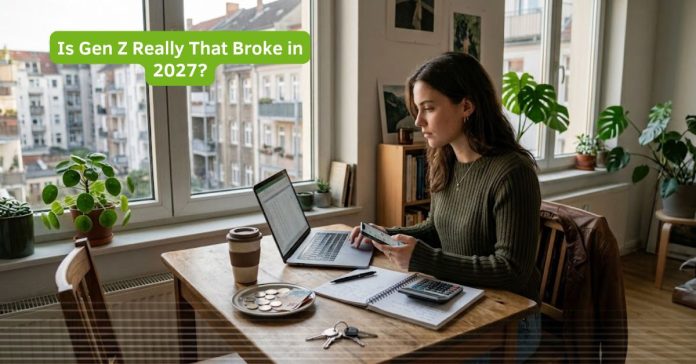
Open TikTok and someone is crying about rent. Open the news and a man in a suit is telling you that we’d all have houses if we didn’t all purchase iced coffees. Gets to a birthday party and after about 10 minutes someone blurts out, “I will literally never own a home. The broke Gen Z story is all around. So I did what anyone with a curious mind would do and looked at the actual figures and discovered that things are far from rosy for Gen Z – or are they? Spoiler: it’s messier. Way messier.
The Numbers Are Not Cute
First the bad news: I believe in peeling the plaster off.
A survey released by Deloitte in 2026 revealed that 47% of the generation Z and Millennial young people in the world live from paycheck to paycheck. Approximately one-third of these are at or below the minimum level needed to pay their basic monthly costs. Our top concern for the past five years is cost of living. Five. Years.
One May 2026 MoneyLion survey revealed that 33% of Gen Z were very concerned about the difference between how much they make and how much they need, which is the highest of any group. Boomers took home the 15% spot.
So when they ask, is Gen Z really that broke, the honest answer is, a lot of us yes. This isn’t a vibe. It’s data.
Why It’s Not Our Fault (Mostly)
Here are the things the iced coffee man doesn’t tell you about. We did not select the time.
We have come into the job market at the end of a pandemic, amid an inflationary surge, and with almost stagnant at-entry wages. Consumer prices in the US have increased by about 25% over the past five years. Likely, you haven’t received the memo about your pay.
Not to mention student debt. According to Statistics Netherlands the average amount of debt owed by students in the Netherlands is approximately €18,200, and this is most in the age group 25 to 30. Correct when you should be “getting your life together.
Housing Is the Final Boss
The one thing that makes Gen Z feel poor is housing. There’s really nothing else that compares.
The Dutch Situation
The Netherlands lacks around 410,000 houses, equivalent to 4.8% of all housing in the Netherlands. New tenants paying rents in the free sector on average paid €1,882 per month in the second quarter of 2026. As a general rule, landlords would require you to have three times the rent to afford an average landlord. So if it costs €1,550 per month, you need €5,650 per month. I’ll give you a chance to crack a joke.
Buying? This year, it cost on average around €487,000 to buy an existing home. And the number of under-25s getting their first place dropped from 125,000 in 2023 to 96,000 in 2024. People do not live with their parents for the comfort. They stay because there’s no where else to go.
It’s Not Just Us
One in two young people (51%) in the Deloitte survey said they simply cannot afford to buy a house — a global figure.In the global survey, 1 in 2 young people (51%) said they simply cannot afford to buy a house. Two thirds indicated housing costs influence their place of employment. Well, if you could choose your career simply by where you can find a bedroom, where would you go?
Plot Twist: We’re Actually Good With Money
So for the part people don’t put in the news these days.
According to the World Economic Forum, 30% of Gen Z began investing at an early age, which is double the rate for Gen X (9%) and boomers (6%). And 86 percent of us had been introduced to investing before we were first introduced to the labor force. Schwab puts the average age a Gen Z investor starts at 19.
That’s what makes apps like Revolut and Trading 212 different. You can contribute €10 to an index fund from your bed, in a face mask without any guy in a suit present.
We’re saving too. A January 2026 Urban Institute survey revealed that 42% of young adults are saving for retirement. The financial regulator revealed in its report in 2026 that the average saving of Gen Z increased and the average debt decreased since 2023.
Of course one proviso, as I promised to be realistic… A 2026 Betterment survey reveals 60% of Gen Z investors rely on social media for the majority of their financial news, with over half admitting to transferring investing funds into sports betting. We are told, but not spared, of nonsensical things. Do the research, darling!
Broke But at the Concert
That’s where older generations go crazy. So high prices, why are we at festivals?
According to data from Luminate, early 2026 U.S. concertgoers averaged $101 monthly on live music, surpassing the millennials.
Why This Actually Makes Sense
Do the maths. You won’t get to a house worth €487,000 by not going to a €150 concert. If the big dreams are behind a wall, the big spending on small joys is no longer reckless, but logical.
There’s psych in it as well. Experiences make people happier for longer than stuff does and add to memories and friends. We’re having a lot of fun being in a crowd screaming lyrics, of course, after a portion of our teens was spent in the house.
If it’s ticket money we are talking about, is Gen Z really that broke? We can be both. When you’re tight on time, make time for fun.
Gen Z and Luxury Fashion: It’s Complicated
This is my favorite costume change. For years, luxury brands have been hiking up the prices, and Gen Z has walked away quietly. From 2022 to 2024 Bain identified that the luxury consumer base has reduced, by approximately 50 million, with our generation being the largest hit. The luxury goods industry is forecast to grow slowly in 2026.
We didn’t cease to care for nicety. Simply became more intelligent. According to ThredUp’s 2026 report, 62% of Gen Z purchased something used last year, while 67% consider the resale value of an item before making a purchase. From huge catches to getting a single great find.
The flex for 2027 isn’t the logo. The old fashioned item, the designer purse that has been used, the perfume rather than the purse.
Side Hustles Are the New Normal
According to Deloitte, almost 1 in 3 Gen Zs globally has a part-time job in addition to their primary role, while some studies in the US indicate that it could be as high as 50%. Selling used clothes, freelancing, making content, tutoring, it’s all about it.
The creator economy isn’t a get-rich scheme and most people don’t give up their jobs for it. However, an additional couple hundred dollars per month between stressed and okay. It’s not hustle culture. Survival by ring light.
Where itismandystyle Comes In
That is the reason this blog is in existence. Those who feel that they look good only when they earn more money that they actually have are wrong.
This is all about that: the basics you should invest in, the ones you should pass on, how to restyle what you already have, how to thrifty well. It wasn’t like anything was about affordability.
So, What’s the Verdict?
So, is that Gen Z broke? Structurally, yes. Spotify’s cancellation does not solve the housing, the debt and the prices are all against us.
But we’re also investing at a younger age, saving more, shopping smarter and creating an additional income stream as if it were our job. Sometimes, it is. But it’s not all about being broke. Resourceful is.


