
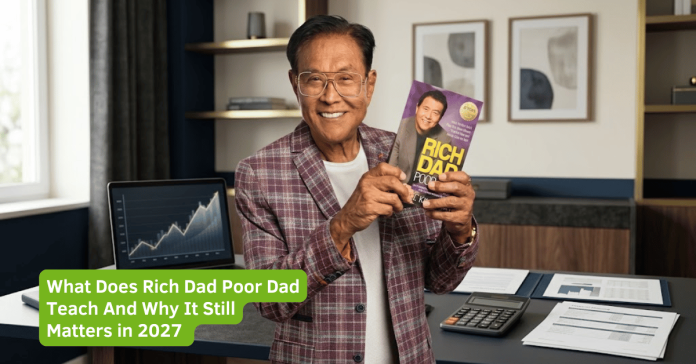
Rich Dad Poor Dad is one of the most influential personal finance books in the lives of ordinary people. It’s been almost 30 years since it came out, and it remains a bestseller, social media talking point and dinner table discussion. We at Moneydiggers are committed to learning from those who helped make the conversation possible, and thinking our own thoughts. So, let’s dissect what this book teaches, what is still relevant and what you should say goodbye to in a bid to reach 2027.
A Brief Overview: How a Self-Published Book Became a Global Phenomenon
Rich Dad Poor Dad was published in 1997, first by the authors themselves because the traditional publishers did not take an interest. The book is about two fathers. The “poor dad” was Kiyosaki’s biological father, a very educated government worker who worked hard, but had financial difficulties in Hawaii. The “rich dad” was the father of a childhood friend of his who is a businessman and had very little formal schooling who made his money in businesses and property.
The book was originally spread by word of mouth, and was thrust into the mainstream by a large television event in the year 2000. It has been a bestseller in personal finance, parenting and investing literature, and is in the top-selling books for over 40 million copies sold worldwide, according to its publisher’s descriptions.
What made it so popular? Because it spoke of something millions of people felt but could not articulate: School taught them how to make a living, but not how money works.
The 6 Core Rich Dad Poor Dad Lessons in a 2027 Context
The book is structured in six lessons. The lessons 2027 of Rich Dad Poor Dad can really be applied in today’s economy of remote work, side businesses, online platforms and higher living expenses.
Lesson 1: The Rich Don’t Work for Money
Kiyosaki believes that for most people, work for a paycheck is a process of fear, which is a response to the fear of not paying bills, and desire, which is a desire for more things. The rich, on the other hand, construct mechanisms to create profits that yield an income without the need for constant effort.
Lesson 2: Why Teach Financial Literacy?
But wealth isn’t the amount of money you make, it’s what you save and invest. If revenue increases, spending increases as well, so the doctor who makes a lot of money can be destitute. The base is financial literacy, or the ability to read numbers and understand cash flow.
Lesson 3: Mind Your Own Business
Your job is your employer’s business. “The asset column” is your “own business,” Kiyosaki’s phrase. Don’t ditch your day job, but develop something on the side that’s yours.
Lesson 4: The History of Taxes and the Power of Corporations
A business owner/investor has access to tax benefits that an employee does not. Kiyosaki says this is a case in point. The details will depend on country, but the overall idea is that the knowledge of your local tax code is a valuable asset and not a burden.
Lesson 5: The Rich Invent Money
A good opportunity is seldom seen by the unaided eye. Financial intelligence will enable you to see deals, solve problems and generate value that others can’t.
Lesson 6: Work to Learn, Don’t Work for Money
Select work opportunities for skills acquired, particularly Sales, Communication, Management and Finance. Keeping up with learning and adapting will be the most valuable skill in 2027 as AI transforms many professions.
Assets vs Liabilities: The Most Important Concept in the Book
If you have one idea to take from the book, it’s this one. Kiyosaki’s definitions are deliberately simple. An asset is something that takes money out of your pocket. A liability is something that costs you money.
This turns the accountants’ world upside down. In Kiyosaki’s definition, your car, your newest phone and even your home, if you have a mortgage and no rental income, are all liabilities because they are taking cash out from your wallet each month. Some assets provide you cash, such as a rental property, a dividend-paying stock portfolio, a profitable online business or royalties from your intellectual property.
The poor invest in liabilities, believing that they are investments. As income increases, the middle class assumes greater debt, such as that for a car or a mortgage. The abundant emphasis on asset accumulation as a means to enjoying a lifestyle later in life.
In an era of apps that let you pay later and subscription creep, this single lens can make a difference in a household budget. Before making any big purchase, ask yourself this simple question: Will it eat me or feed me?
Why the Rich Don’t Work for Money, and How This Applies Today
Kiyosaki was not making the claim that the rich are lazy. It’s because their money earns more than their work does. A salary only continues to be paid, when you continue to work. Assets keep producing.
The concept of this idea is now more available than in 1997. A designer can make some money with templates while he is sleeping. Teachers can create a course. Using the phone app, a small investor can purchase fractional shares of an investment or index funds for a few dollars. These tools have made ownership of them open to everyone. The only thing that hasn’t changed is the attitude necessary to utilize them: patience, discipline and the ability to postpone satisfaction.
The Moneydiggers motto is: goal diggers, not gold diggers. We work, we hustle, we think, we dig and we find solutions. It’s not a problem to work hard! The hard work that is done solely for the benefit of others is.
The Rat Race Explained, and How to Escape It in 2027
The Rat Race is the cycle of earning, spending and borrowing which keeps people running in place. You are given a salary increase, you buy a more luxurious home, your bills go up, and you need a further increase to keep your standards the same!
The first quantifiable step to get out of it is to start generating a Passive Income that’s greater than your monthly expenses. Kiyosaki was able to convey this in his game Cashflow, which teaches people how to make enough income from the assets they create to pay their expenses.
The escape route in practical 2027 is as follows. Number one: Keep track of all your dollar so you can be aware of what you really spent. Second, eliminate any debt that sucks capital out of the business. Third, make sure you have enough cash reserves in case the crisis forces you into more debt. Fourth, change the imbalance between income and expenditures to income generating assets. Fifth, save that income until you can support yourself. It’s slow, unglamorous and it works.
How the Book’s Lessons Apply to Investing in 2027
Real Estate
The rental business is Kiyosaki’s signature mode of transportation. The lesson remains: Do not purchase with expectations of capital gains. Given that we have some rates that are well above the ultra-low rates of the early 2020s, it’s deals that have to be meaningful on a monthly basis, not dreams.
Stocks
Kiyosaki has been critical of conventional retirement plans and mutual funds for a long time. However, when they generate income, stock in the dividend and low-cost index funds are a perfect fit for his asset definition. They are the most straightforward way of starting to become an owner for most beginners.
Crypto and Precious Metals
Kiyosaki has been one of the most vocal advocates for hard assets. He has set goals of $27,000 for gold, $100 for silver and $250,000 for Bitcoin by 2026 – and in March 2026 he took things up a notch, predicting a year could pass from an economic crisis until those prices were reached. Notably, he also conceded that his prediction could be wrong. Don’t follow these as a strategy, a plan. Volatile assets can be a component of a portfolio, but should not be the supporting structure.
Business
Kiyosaki believes that the best asset one can have is being a business owner. Now more than ever, when a laptop and Internet connection can start a service or product with little capital expenditure. The Rich Dad Poor Dad lessons 2027entrepreneurs need to apply to creating systems not jobs for yourself.
Criticism: What the Book Gets Wrong or Oversimplifies
There are many critics and a fair review should include them.
Questions About Rich Dad Himself
For a long time the question has been asked whether ‘rich dad’ was a real person or a fictional character. Kiyosaki has been able to defend the story, but there has never been a definite figure to match the description in the book. Some readers consider this book more as a parable than a memoir.
Light on Specifics, Heavy on Risk
Mindset is more than method in this book. It fosters aggressive use of debt, creative financing and deals on real estate without explaining how these strategies can backfire. Increasing loss is the same as increasing gain.
Dismissing Education and Savings
The many times Kiyosaki has said “savers are losers” is a risky thing to take literally. If you don’t save, you won’t have the funds to ride out the storms of life or take advantage of good investment times. The importance of formal education, on the other hand, as one of the more dependable routes for increased lifetime earnings continues to be one of the most important for many individuals.
The Author’s Own Track Record
One of Kiyosaki’s firms, Rich Global LLC, went bankrupt in 2012 after receiving a big judgment in court for a disagreement with a seminar partner. He has also had a number of times he has been right about his crash predictions in years. None of this takes away from the great ideas that the book has to offer, but it does give me an opportunity to remind myself to differentiate between the message and the messenger.
The Bottom Line: What to Take and What to Ignore
Take the mindset. Be familiar with assets and liabilities. Create an income stream that isn’t reliant on your day job. Continue to invest in financial education on an ongoing basis. Be careful when you get “lifestyle inflation”. Prioritize skills over salary as a junior.
Ignore the extremes. Don’t skip saving. Avoid taking on debts that you are unable to pay off. Avoid putting your future on any one person’s predictions, even Kiyosaki’s. Do not disregard any education or stable job opportunities; leverage them.
The value of the Rich Dad Poor Dad lessons 2027 readers can take from this is not in any particular tactic. It’s the question the book makes you ask: am I working for money, or is money working for me?
The first question every goal digger starts asking is that one. The following lessons from Rich Dad Poor Dad are simple: Educate yourself about the rules of money; patiently acquire assets; think critically; and continue working to get out of the rat race until you find your own way out.


